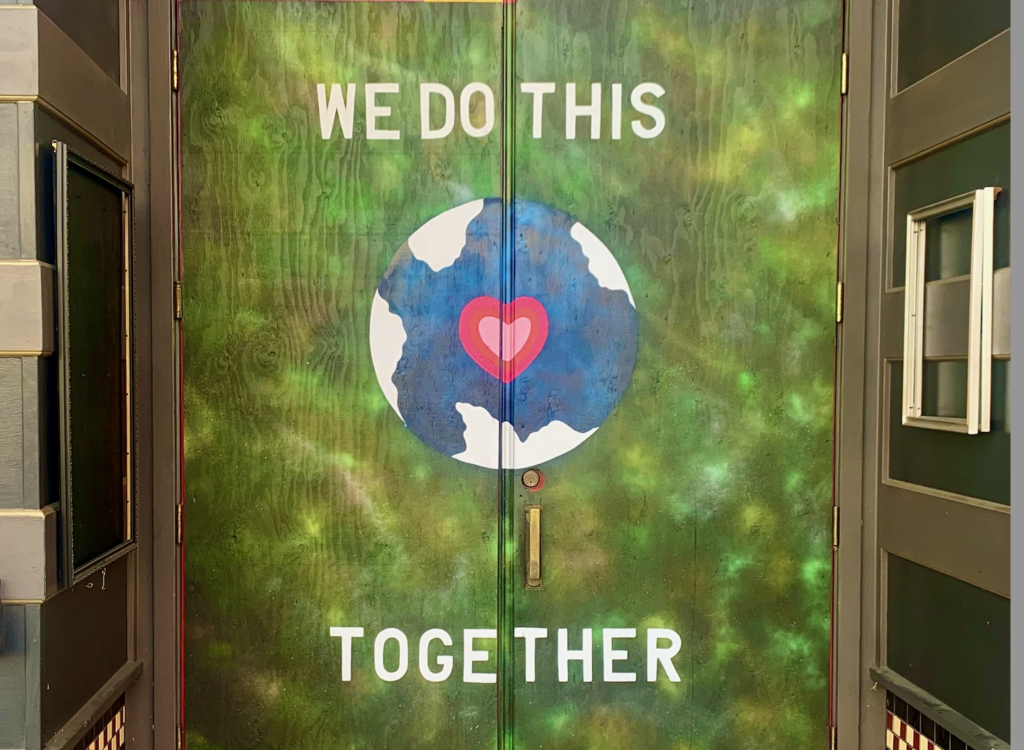

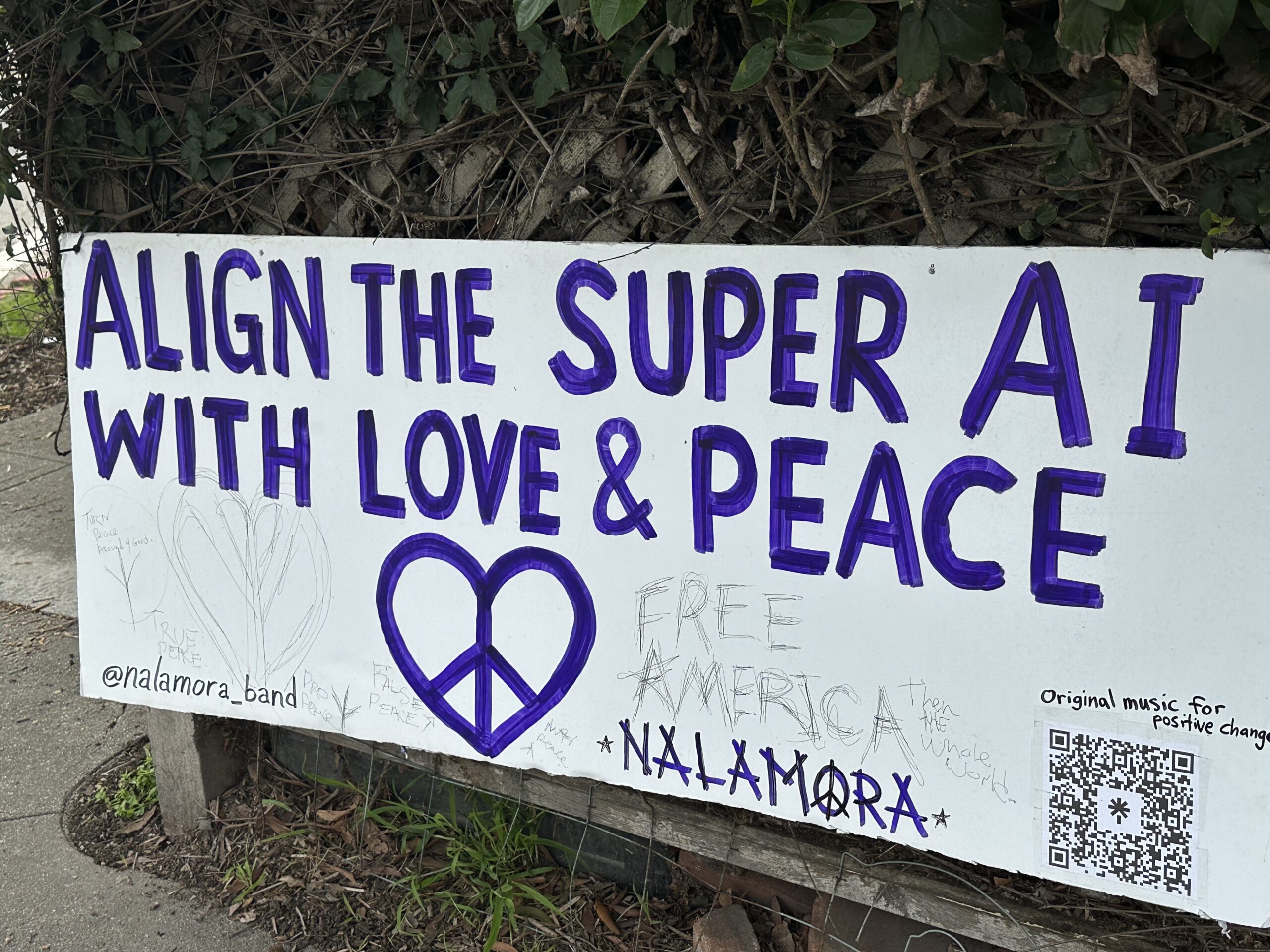
[The image is our TU universal goal aspiration for AI, as inspired by a banner on a fence near UC Berkeley’s Lab]
Often called equity 2.0, Targeted Universalism (TU) is a process and practice to address today’s complex problems through affirmative, universal goals in service to equity, belonging and the social good. TU addresses individual, group and place-based situatedness, and the complex ways that othering both occurs and is embedded in structures, systems, institutions and cultures. It’s designed to remove barriers, reduce inequity and to proactively builds new ways, new structures and opportunities of care, well-being and belonging.
One of the best way to learn TU is through case studies, within communities of practice and experiential team learning and incubators–and just getting started. In that spirit, below are an abundance of case studies, with more to be found on OBI’s TU Bibliography, collated by Wendy Ake.
“Targeted universalism means setting universal goals pursued by targeted processes to achieve those goals. Within a targeted universalism framework, universal goals are established for all groups concerned. The strategies developed to achieve those goals are targeted, based upon how different groups are situated within structures, culture, and across geographies to obtain the universal goal. Targeted universalism is goal oriented, and the processes are directed in service of the explicit, universal goal.
Targeted universalism is a platform to operationalize programs that move all groups toward the universal policy goal as well as a way of communicating and publicly marketing such programs in an inclusive, bridging manner. It is an approach that supports the needs of particular groups, even the politically powerful or those in the majority, while reminding everyone that we are all part of the same social and civic fabric. As such, targeted universalist policies are more resistant to the critique that government programs serve special interests, whoever that might be–From the OBI Targeted Universalism Primer by john a. powell, Stephen Menendian, and Wendy Ake
Take a Seat at Oregon’s Kitchen Table: Adapting Targeted Universalism for Broad and Deep Civic Engagement: An article discussing the application of a TU model in the state of Oregon for “Oregons Kitchen Table”, a civic engagement program meant to gather feedback from a wide array of community members to engage more civic participation and to bridge the gaps of civic participation. The article discusses the ways in which a TU approach may struggle in a political context, such as bringing together a large group of differing stakeholders due to logistical and group constraints.
Francis-Oliviero, Florence et al. 2020. “Theoretical and practical challenges of proportionate universalism: A review.” Rev. Panam Salud Publica 44: 110 https://doi.org/10.26633/RPSP.2020.110.
Jacques, Olivier and Noël, Alain. 2021. “Targeting within universalism.” Journal of European Social Policy 31, no. 1 (February): 15–29. https://doi.org/10.1177/0958928720918973.
Fuentes-Rohwer, Luis, and Guy-Uriel Charles. 2021. “Pathological racism, chronic racism, and targeted universalism.” California Law Review 109, no. 3: 1107. https://www.repository.law.indiana.edu/cgi/viewcontent.cgi?article=3997&context=facpub.
Godwin, Katherin. 2023. “Targeted universalism uses social capital to increase equity in COVID-19 recovery.” ncIMPACT Initiative, University of North Carolina, https://ncimpact.sog.unc.edu/2022/12/targeted-universalism-social-capital-increases-equity-in-covid-19-recovery/.
Farmer, Thomas W, et. al. 2022. “The Developmental Dynamics of Emotional and Behavioral Difficulties of Youth of Color: Systemic Oppression, Correlated Constraints, and the Need for Targeted Universalism.” Journal of Emotional and Behavioral Disorders 30, no. 2: 71–85. https://doi.org/10.1177/10634266211068892.
Farmer, Thomas W., David L. Lee, William J. Therrien. 2022. “Targeted universalism and tiered systems of adaptive support: Centering intervention on the developmental needs of students with exceptionalities. In Handbook of special education research, edited by Thomas W. Farmer, et. al. Oxfordshire: Routledge.
https://www.taylorfrancis.com/chapters/edit/10.4324/9781003156857-29/targeted-universalism-tiered-systems-adaptive-support-thomas-farmer-david-lee-william-therrien.
Leubolt, Bernhard, Karin Fischer, and Debdulal Saha. 2014. “Are targeting and universalism complimentary or competing paradigms in social policy? Insights from Brazil, India, and South Africa.” International Journal of Labour Research 6, no. 1: 75-94. https://labordoc.ilo.org/permalink/41ILO_INST/1s2ok2m/alma994847783402676.
Perry, Ravi K. 2013. “Deracialization Reconsidered: Theorizing Targeted Universalistic Urban Politics.” In 21st Century Urban Race Politics: Representing Minorities as Universal Interests, edited by Ravi K Perry, xxiii-xliii. Bingley: Emerald Group Publishing Limited. https://doi.org/10.1108/S0195-7449(2013)0000018004.
Perry, Ravi K. 2013. “Epilogue: Future Prospects for Targeted Universalism.” In 21st Century Urban Race Politics: Representing Minorities as Universal Interests, edited by Ravi K. Perry, 297-300. Bingley: Emerald Group Publishing Limited. https://doi.org/10.1108/S0195-7449(2013)0000018018.